
Redefining motor drives with 1 MHz GaN switching

James Cannings, CEO at QPT, discusses the world’s first 1MHz GaN motor drive, and the recent opening of customer demonstrations of its MicroDyno test platform, now updated with full Field Oriented Control (FOC) and real-time dynamic cogging correction. James also discusses the launch of qDesign, an AI-driven generative design service that programmatically generates, simulates and iterates on QPTs patented qAttach thermal interface layer for any power module, replacing weeks of human-in-the-loop CAD and simulation cycles with AI-generated topologies and automated optimisation
For more than two decades, motor drive technology has evolved through incremental improvements rather than fundamental architectural change. Silicon devices became more efficient, silicon carbide extended operating voltages and temperatures, and software delivered increasingly sophisticated field-oriented control (FOC). Yet despite these advances, one characteristic has remained remarkably constant: switching frequencies have largely remained around 10 kHz.
According to James Cannings, CEO at QPT, that ceiling is no longer a technological necessity - it is a historical limitation that has constrained the entire motor drive ecosystem.

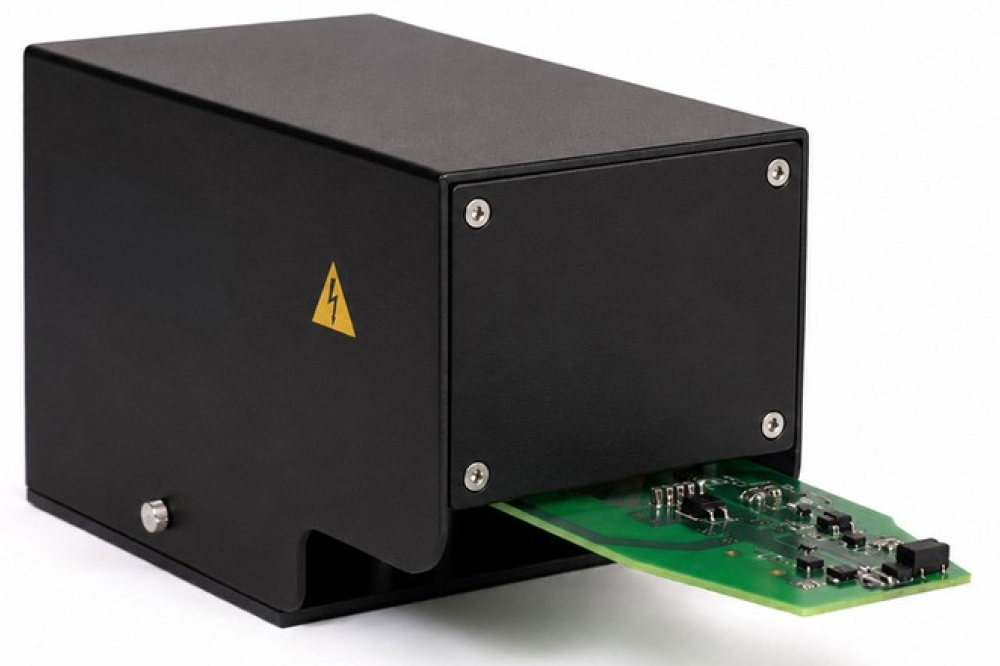
MicroDyno running Field Oriented Control natively at 1MHz hard-switching with dynamic cogging correction active to eliminate torque ripple in low-cost motor.
QPT’s latest demonstration platform, MicroDyno, claims to be the first commercial platform capable of running field-oriented control natively at 1 MHz hard-switching. Achieving this required far more than replacing silicon with gallium nitride (GaN). It demanded an entirely new approach to semiconductor packaging, thermal management, gate driving and system architecture.
If the technology delivers on its promise, the implications extend well beyond faster switching. The platform could fundamentally alter motor design, reduce system bill-of-material costs, eliminate expensive shielding, enable precision motion using commodity motors and provide unprecedented diagnostic capabilities through software-defined sensing.
Speaking with Power Electronics, Cannings outlined why QPT believes the industry is approaching its biggest shift since vector-controlled drives became mainstream.
Breaking the 10 kHz barrier
Traditional motor drives operate between roughly 4 kHz and 16 kHz, with approximately 10 kHz representing the practical operating point for most commercial systems.
While silicon carbide has extended performance, it has not fundamentally changed this operating paradigm.
“You can push silicon carbide higher,” explains Cannings. “Perhaps 50 kHz, maybe even approaching 100 kHz in specialist applications, but the motor itself increasingly becomes the limiting factor.”
The reason lies in pulse-width modulation. Conventional inverters present the motor with fast voltage transitions that approximate a sine wave. As switching frequency increases, electromagnetic interference, insulation stress, bearing currents and cable losses become increasingly problematic.
Rather than attempting to optimise this architecture, QPT has changed it entirely. Instead of delivering PWM directly to the motor, MicroDyno produces a fully filtered sinusoidal voltage output.
“The motor never sees the switching waveform,” Cannings explains. “It simply sees the clean sine wave it actually wants.”
The distinction is significant. Although sine-wave filters have existed for years, their size has prevented widespread adoption. At conventional switching frequencies they can weigh tens of kilograms while introducing additional losses and cost.
Frequency changes everything. Increasing switching frequency by roughly two orders of magnitude allows the passive filter to shrink dramatically.
“A filter that might weigh 25 kilograms at 10 kHz becomes approximately 250 grams at 1 MHz,” says Cannings.
Instead of becoming an expensive specialist accessory, the output filter becomes practical for mainstream drives. The result is an inverter that presents the motor with an almost ideal voltage waveform while simultaneously reducing acoustic noise, electromagnetic emissions and insulation stress.
Why 1 MHz requires more than GaN
At first glance, GaN appears to make 1 MHz switching inevitable. Its intrinsic switching speed significantly exceeds silicon and silicon carbide, making megahertz operation theoretically possible. The practical reality has proved rather different.
“The semiconductor has never really been the limitation,” Cannings says. He references comments made by GaN pioneer Geoff Haynes, co-founder of GaN Systems, who remarked during the company’s early product launches that creating the transistor had been “the easy part”.
“The difficult question,” Cannings says, “was always how you actually use these devices.”
Packaging quickly became the bottleneck. Conventional power modules were designed around silicon. Simply replacing the die with GaN does not unlock its full switching capability.

MicroDyno’s analysis view showing high-resolution data captured without external sensors. Uniquely possible with high SNR from the pure sine wave motor drive.
Cannings compares the situation with a recent analogy used within the semiconductor industry.
“As Infineon recently put it, putting a Ferrari engine into a tractor still leaves you with a tractor.”
The challenge therefore extends across multiple engineering disciplines.
Efficient 1 MHz hard switching demands switching transitions of approximately one to two nanoseconds while managing voltage slew rates exceeding 550 V/ns. That creates simultaneous RF, thermal and packaging problems.
According to Cannings, solving those problems required years of development across custom gate drivers, electromagnetic design and entirely new packaging technologies. “Our half-bridge modules probably have more in common with RF systems than traditional power electronics.”
qAttach: Solving the thermal challenge
Central to QPT’s approach is a proprietary die-attach technology known as qAttach.
Thermal interfaces are often overlooked outside semiconductor packaging circles, yet they frequently dictate long-term reliability and power density. Conventional solder layers introduce significant thermal resistance. Silver sintering improves thermal performance but requires substantial pressure during manufacturing while still imposing practical thickness limitations.
QPT instead employs an ultra-thin solder layer - potentially below one micron - combined with a complex surface topology that prevents delamination.
The concept is perhaps best illustrated through an unexpected analogy. One customer compared the design to anti-rip materials used in paragliders. Modern paraglider fabrics divide the surface into numerous small sections so that any tear cannot propagate across the wing. Cannings believes qAttach behaves similarly.
Its structured interface prevents cracks from spreading while maintaining an exceptionally thin thermal path. The outcome is thermal performance reportedly up to fifteen times better than conventional die attachment while avoiding the manufacturing pressures associated with sintering.
Beyond motor drives, the approach has immediate relevance to AI data centre power supplies, where thermal density increasingly limits system performance.
Seeing without external sensors
While 1 MHz switching provides cleaner motor drive signals, it also unlocks another capability: vastly improved observability. Because the motor receives a pure sinusoidal voltage, returning electrical signals are no longer buried beneath switching noise. This enables extremely accurate measurement of back electromotive force (back EMF).
Internally, QPT samples current and voltage at approximately 4 MHz. The resulting signal quality allows the inverter itself to become an intelligent sensing platform. Cannings prefers to describe the capability as “sensing without external sensors.” The distinction matters.
The drive continues to measure electrical quantities internally, but no longer requires large numbers of external sensors distributed throughout the machine. Instead, subtle disturbances become visible through the electrical behaviour already present within the motor. “The quality of the data changes completely,” he explains. That richer dataset becomes the foundation for predictive diagnostics, adaptive control and AI-based analysis.
Eliminating cogging without lookup tables
One of the first public demonstrations of this sensing capability focuses on torque cogging. Cogging torque results from magnetic imperfections within electric motors and normally requires expensive motors, high-resolution encoders or carefully characterised lookup tables to compensate. QPT instead demonstrated dynamic correction using a deliberately inexpensive motor.
By observing disturbances within the back EMF signal, the controller continuously estimates torque ripple and applies corrections in real time. No calibration tables are required. No lengthy commissioning process is needed. The result is precision typically associated with significantly more expensive servo systems. Cannings believes this could dramatically reduce robotics costs.
Rather than specifying premium servo motors costing several hundred pounds together with high-resolution position encoders, manufacturers could potentially achieve similar performance using commodity motors controlled by intelligent electronics. “We’re demonstrating precision motion using a motor that cost around fifty dollars.”
Reducing system costs
The implications extend beyond motor selection. One of the less visible costs in industrial automation is cabling. Fast PWM waveforms require expensive screened motor cables to limit electromagnetic interference.
In large industrial installations, these cables frequently cost more than the inverter itself. Because QPT outputs a clean sine wave, screened cabling may no longer be necessary. For large factories containing hundreds of metres of cable per motor, the savings become substantial.
Robotics offers another compelling opportunity. Each joint within a collaborative robot typically incorporates premium servos, precision encoders and associated electronics.
Cannings estimates that QPT’s architecture could potentially remove between £500 and £1,000 per linkage. Across six-axis robots, those savings rapidly become several thousand pounds per machine.
Longer term, similar thinking could influence electric vehicle motor design. Much of today’s motor engineering exists specifically to accommodate PWM excitation. If motors instead receive pure sinusoidal drive voltages, some of those design compromises disappear. Preliminary analysis suggests this could reduce EV motor costs by around 20%, although Cannings acknowledges automotive qualification cycles will inevitably take considerably longer.
Digital twins meet Edge AI
MicroDyno incorporates another increasingly important capability: integrated digital twin technology. Rather than transporting large demonstration systems, engineers can recreate complete motor behaviour digitally. More importantly, digital twins provide an efficient environment for AI training.
QPT first models normal motor operation across varying loads before injecting simulated faults including bearing defects and electrical abnormalities. Large datasets generated from these simulations are then used to train compact edge AI models. Once deployed, the drive continuously monitors incoming data. Within milliseconds it identifies abnormal behaviour before passing observations to a fault classifier.
Cannings acknowledges that predictive maintenance itself is not new. Many industrial suppliers already offer AI-assisted diagnostics. The challenge has always been deployment cost. Traditional systems rely upon multiple external sensors throughout the machine. QPT instead extracts comparable information directly from the motor drive. Because the sensing already exists inside the inverter, the incremental hardware cost becomes negligible.
“We’re really exploiting the richness of the electrical data already available,” Cannings says.
Accelerating power module design with AI
Beyond motor drives, QPT recently introduced qDesign, an AI-assisted design environment intended to accelerate semiconductor packaging development. The system addresses one particularly labour-intensive challenge: customising qAttach geometries for different power modules. Each module possesses unique thermal hotspots, mechanical stresses and coefficient-of-thermal-expansion mismatches.
Traditionally, engineers construct highly detailed CAD models, perform finite-element simulations, manually review results and then begin another design iteration. Each cycle can consume weeks.
qDesign instead uses large language models to generate parametric geometry programmatically using Python and Build123D. Importantly, the AI does not immediately produce manufacturing data. Every design passes through deterministic validation stages ensuring manufacturability, assembly feasibility and compliance with production constraints before entering simulation. Human engineers remain firmly within the process. “The AI isn’t replacing engineering judgement,” Cannings emphasises. Instead, it performs the repetitive optimisation work that humans struggle to execute efficiently.
Simulation outputs containing millions of stress values become machine-readable optimisation inputs. The AI modifies microscopic surface geometries before generating revised models for further evaluation. Rather than weeks per iteration, optimisation cycles can complete within 24 hours.
Just as importantly, AI explores parameter combinations that human engineers would rarely attempt manually. Although QPT has yet to discover radically unexpected geometries, Cannings believes customer programmes over the coming months will increasingly demonstrate genuinely novel solutions.
Beyond motor drives
Although MicroDyno has attracted attention for motor control, Cannings emphasises that QPT’s packaging technologies extend well beyond industrial drives.
AI data centres represent another significant opportunity. Increasing rack power densities demand smaller, cooler and more efficient power conversion hardware. Many of the same innovations enabling 1 MHz motor drives - including advanced die attachment and high-frequency magnetic components - translate directly into data centre power supplies. In this sense, motor drives simply represent the company’s initial commercial focus rather than the limit of its technology.
A licensing strategy
Unlike many semiconductor startups, QPT does not intend to manufacture complete power modules. Instead, it plans to license its intellectual property to semiconductor manufacturers and established module suppliers. Cannings believes this provides the most practical route to industrial adoption. Large OEMs remain understandably cautious about relying upon a small startup for critical supply.
Embedding QPT technology within existing global manufacturing ecosystems provides a lower-risk adoption pathway. Collaborative development projects begin with existing customer modules before optimising qAttach geometries and validating performance through accelerated simulation enabled by qDesign. Only then does manufacturing begin.

qDesign iterating on programmatically generated qAttach thermal-interface geometries. Fully AI generated attach layer enables rapid iteration and optimisation.
The bigger challenge: Industry adoption
From a purely technical perspective, Cannings believes the case for sine-wave motor drives is compelling. The more difficult challenge may prove organisational rather than engineering.
Today’s industrial ecosystem evolved around conventional PWM drives. Motor manufacturers, drive suppliers, cable vendors and systems integrators often operate as separate businesses with different commercial incentives. A technology capable of reducing costs across the entire system does not necessarily benefit every participant equally. Drive manufacturers may have spent decades reducing inverter costs by a few cents. Introducing an architecture that fundamentally changes cable requirements, motor design and system economics demands new commercial thinking.
Automotive companies, Cannings argues, may prove more receptive because they already optimise complete vehicle efficiency rather than individual subsystem performance. Industrial automation could require a longer educational process.
Looking ahead
Every generation of power electronics eventually reaches an inflection point where incremental improvement gives way to architectural change. Silicon carbide extended operating voltage. GaN extended switching speed. QPT argues that the industry’s next transformation comes not simply from faster semiconductors but from redesigning the entire system around what those semiconductors make possible.
If successful, motors may eventually be driven exclusively by clean sinusoidal waveforms rather than approximated PWM signals. Acoustic noise could disappear. Cable costs could fall. Commodity motors could perform like precision servos. Motor drives could become intelligent sensing platforms. And semiconductor packaging - traditionally hidden beneath the surface - could emerge as one of the industry’s most important enabling technologies.
Whether this vision becomes mainstream remains to be seen.
Industrial qualification cycles are notoriously conservative, particularly within automotive and mission-critical applications. Yet as power density, efficiency and system intelligence continue to dominate engineering priorities, QPT’s work illustrates an increasingly important point.
The next revolution in power electronics may not come from inventing a faster transistor. It may come from finally building the system architecture that allows those transistors to fulfil their potential.