From conversion tax to DC-native: Re-engineering data centre power for the AI Era

An interview with Dafna Granot, senior manager strategy and innovation at SolarEdge, author of the white paper: Powering the AI revolution: A Maturity Roadmap to Integrated 800V DC, who discusses the five-stage maturity model for data centres to transition from AC to DC-native infrastructure and the role played by Solid-State Transformers in defining the next generation of AI factories.
The rapid expansion of artificial intelligence (AI) workloads is forcing a fundamental re-evaluation of how data centres are powered. For decades, alternating current (AC) has served as the foundation of data centre electrical infrastructure, supported by mature standards, well-established supply chains, and familiar operational practices. However, the emergence of GPU-intensive AI systems is exposing critical inefficiencies in these legacy architectures, particularly in the form of repeated power conversions that drain energy and limit scalability.
What was once considered an acceptable level of inefficiency - often described as a “conversion tax” - has become a central constraint. As data centres strive to deliver ever greater compute performance within finite power envelopes, the industry is beginning a decisive shift toward high-voltage direct current (DC) architectures. In this transition, 800V DC is emerging as the immediate target, while more advanced DC-native systems promise further gains in efficiency, scalability, and economic return.
AI workloads are driving an unprecedented shift in power density
Traditional data centre applications, such as enterprise computing and web services, typically operated within relatively modest power constraints. Rack densities in the range of 5 to 10kW were once the norm, and infrastructure inefficiencies could be tolerated because the overall demand profile remained manageable.
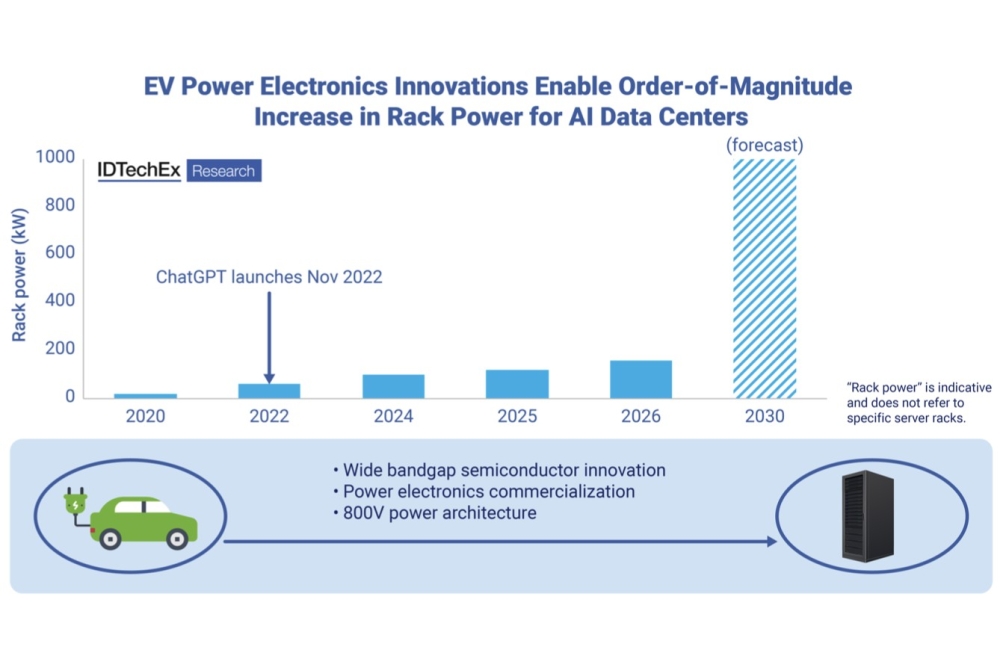
AI workloads are fundamentally different. They require dense clusters of GPUs operating at high utilisation levels, often in tightly integrated configurations that demand both high performance and low latency. This has led to a dramatic escalation in power density. Where 10kW per rack was typical in the past, modern AI deployments frequently reach 100kW per rack, and projections indicate that this figure could rise to nearly 1MW per rack within the next generation of systems.
This rapid increase introduces significant challenges. Existing AC infrastructure places a practical upper limit on rack density, often around 200kW. Beyond that point, thermal management, power delivery, and physical constraints become increasingly difficult to overcome. At the same time, the sheer scale of power being consumed means that even small efficiency losses translate into massive amounts of wasted energy.
The rising cost of conversion losses
Legacy data centre designs rely on multiple stages of power conversion. Electricity typically enters the facility as AC from the grid, undergoes voltage transformation, is distributed throughout the facility in AC, and is then converted into DC within the uninterruptible power supply (UPS). The power may subsequently be converted back to AC and ultimately converted again to DC at the server or rack level, where it is actually used by electronic components.
Each of these conversions introduces losses. When combined, they result in overall system efficiencies that generally fall between 84 percent and 91 percent. In practical terms, this means that a significant portion of incoming energy is dissipated as heat rather than being used for computation.
In the past, this inefficiency was largely accepted. Today, however, it represents a critical barrier. In a large-scale facility operating at 100MW, conversion losses alone can account for upwards of 10MW of wasted power. This wasted energy must also be removed through cooling systems, adding further overhead and complexity.
With AI workloads pushing both capacity and performance limits, such inefficiencies are no longer tolerable. Every unit of power that is lost to conversion is one that cannot be used to operate GPUs or deliver value to customers.
Elevating voltage: the case for 800V DC
One of the most effective ways to improve power delivery efficiency is to increase voltage. Higher voltage enables lower current for the same power level, which in turn reduces resistive losses and minimises heat generation. This principle is particularly important in high-density environments, where thermal constraints are already a major concern.
As a result, the industry is converging on 800V DC as a near-term standard for next-generation data centres. This voltage level offers a balance between performance gains and practical implementation. It allows for significant reductions in current, enabling thinner conductors, reduced material use, and improved overall system efficiency.
Another key advantage of 800V DC is that it is already widely used in other industries. Electric vehicle platforms and solar energy systems have established mature ecosystems around this voltage level, including components, design expertise, and safety standards. This existing infrastructure enables data centre operators to adopt 800V DC without waiting for entirely new supply chains to develop.
While 800V represents a major step forward, it is not the end of the journey. The industry is already discussing a future transition to 1500V DC, which would offer even greater efficiency gains. However, challenges related to safety, standardisation, and component availability mean that 800V is currently the most practical and immediate solution.
A structured path: the five-stage transition model
The shift from AC to DC-native infrastructure is best understood as a progression through several stages of maturity. At the starting point, identified as Stage 0, most data centres operate using traditional AC distribution. These systems are characterised by multiple conversion stages and relatively low overall efficiency.
The first step toward modernisation, Stage 1, involves introducing a local conversion device, sometimes referred to as a sidecar, near the rack. This approach allows operators to support 800V DC loads without fundamentally altering the rest of the infrastructure. While this enables higher-density compute, it does little to address overall efficiency.
Stage 2 builds on this by replacing AC-based UPS systems with DC-based alternatives. This eliminates redundant conversions and increases overall efficiency into the low-to-mid 90 percent range. While still a hybrid approach, it represents a meaningful improvement.
The transition becomes more significant at Stage 3, where the architecture begins to take on a truly DC-native form. This is achieved through the introduction of solid-state transformers, which convert AC to DC and regulate voltage in a single, highly efficient device. By simplifying the power chain, this stage enables efficiency levels approaching the high 90 percent range.
At the final stage, Stage 4, the system is fully integrated around a DC-native design. Here, advanced solid-state transformers incorporate additional functionality, reducing component count and enabling direct connection to medium-voltage grid inputs. This stage represents the highest level of efficiency and the most streamlined architecture.
Solid-State transformers as a key enabler
Central to the evolution toward DC-native data centres is the development of solid-state transformers. Unlike conventional transformers, which perform only voltage conversion, these devices combine multiple functions within a single system. They not only transform voltage but also convert AC to DC and provide power conditioning.
This multifunctional capability allows for a dramatic simplification of the power distribution chain. By reducing the number of conversions required, solid-state transformers improve efficiency and reduce system complexity. They also offer greater flexibility, as their behaviour can be controlled through power electronics rather than fixed electromagnetic designs.
Although the technology is advancing rapidly, solid-state transformers are not yet widely available in commercial deployments. Industry momentum suggests that this will change in the near future, particularly as the rollout of next-generation AI hardware creates demand for more efficient power systems.
The role of silicon carbide in high-efficiency systems
The performance of solid-state transformers and high-voltage DC systems is closely tied to advances in semiconductor technology. In this context, silicon carbide has emerged as a critical enabler.
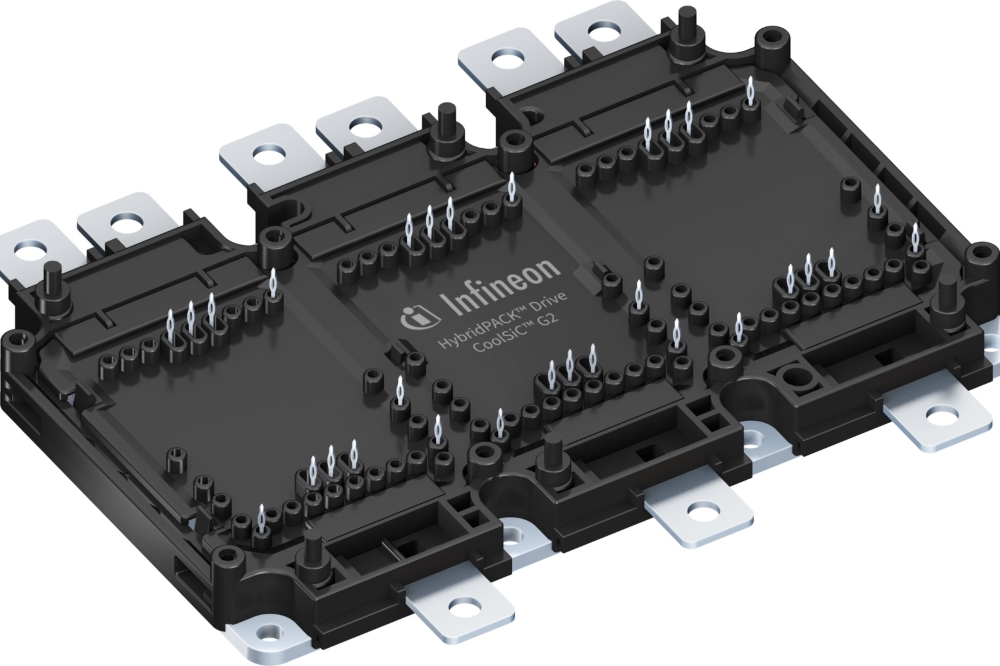
Silicon carbide devices offer several advantages over traditional silicon components. They can operate at higher voltages, making them well suited for 800V and beyond. They also exhibit lower switching losses and lower conduction losses, both of which contribute to improved efficiency. These characteristics are essential for achieving the high performance required in modern data centre power systems.
Although gallium nitride is another promising wide-bandgap material, its current limitations in high-voltage applications make it less suitable for use in large-scale power distribution. However, continued development may expand its role in the future.
Modular architectures and the benefits of scalability
Another important aspect of the emerging DC-native paradigm is the shift toward modular system design. Instead of relying on large, centralised transformers, operators can deploy smaller, standardised building blocks in the range of 2 to 5MW.
This modular approach offers several advantages. It enables faster deployment, as components can be pre-manufactured and installed as needed. It also improves scalability, allowing capacity to be added incrementally in response to demand. From a cost perspective, mass production reduces capital expenditure and shortens lead times, which are currently a significant challenge for traditional transformer procurement.
Modularity also enhances system resilience. In a distributed architecture, the failure of a single module has minimal impact on overall operation. This contrasts with centralised systems, where a single point of failure can disrupt an entire facility.
Overcoming barriers to adoption
Despite its clear advantages, the transition to DC-native infrastructure presents several challenges. One of the most significant is the need for a mature supply chain capable of supporting high-voltage DC components. While progress is being made, the ecosystem is still developing.
Standards and regulatory frameworks are another area of concern. AC systems benefit from decades of established guidelines, whereas DC systems are still in the process of being standardised. Safety considerations are also different, particularly in relation to fault detection and arc suppression, requiring new approaches and expertise.
Additionally, many data centre operators lack experience with DC systems, creating a knowledge gap that must be addressed through education and partnerships with specialised vendors. Finally, the transition can be disruptive, particularly at higher stages of maturity where significant infrastructure changes are required.
Economic imperatives drive change
Ultimately, the move toward DC-native architectures is driven by economic considerations. Efficiency gains translate directly into increased compute capacity and revenue. By reducing conversion losses, operators can reclaim power that would otherwise be wasted and redirect it toward productive use.
In large-scale facilities, even modest improvements in efficiency can have a substantial financial impact. The ability to support more GPUs within the same power envelope not only improves performance but also accelerates return on investment.
Designing for the next generation
For organisations planning new data centre builds, the question of future-proofing has become increasingly important. Facilities expected to come online within the next few years must be designed with emerging AI requirements in mind.
In practical terms, this means planning for 800V DC compatibility and considering how infrastructure can evolve toward fully DC-native architectures. Hybrid approaches may be used during the transition, but the long-term trajectory is clear.
Looking further ahead, the eventual move from 800V to 1500V DC is expected to be less disruptive than the current transition from AC. Many components are likely to be designed with forward compatibility, enabling a smoother evolution.
A new era for power electronics in data centres
The transformation of data centre power infrastructure represents a shift from incremental optimisation to fundamental redesign. As AI workloads continue to drive demand for higher performance and greater efficiency, the limitations of traditional AC systems are becoming increasingly apparent.
High-voltage DC architectures, supported by innovations such as solid-state transformers and silicon carbide semiconductors, offer a compelling path forward. While challenges remain, the direction of travel is unmistakable.
In the era of AI, power electronics has moved from a supporting role to a central position in data centre design. The ability to deliver energy efficiently will not only determine operational costs but also define the limits of computational capability.
The conversion tax is no longer an acceptable compromise. It is a problem that must be solved - and DC-native architectures are emerging as the solution.