800VDC power delivery architecture and advantages for next-generation AI & GPU data centers

A comprehensive comparison with traditional AC-based power systems.
By Sean Burke, CEO of Enteligent (Part 1)
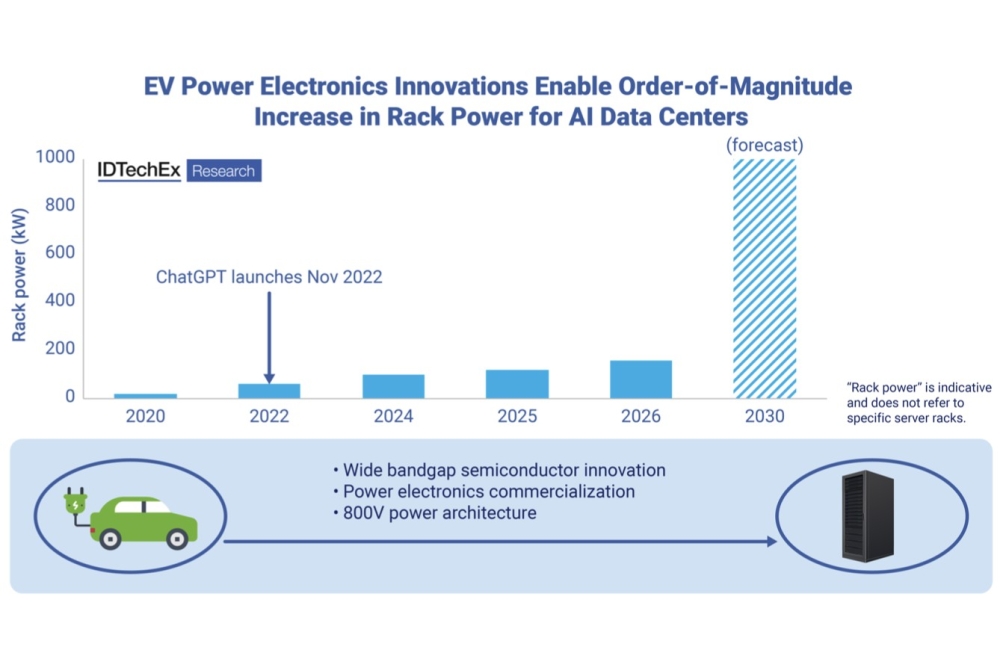
Modern data centers are undergoing a fundamental transformation driven by the explosive growth of artificial intelligence and high-performance GPU computing. The power demands associated with these systems are increasing at a rate far beyond the trajectory of traditional enterprise IT. Whereas historical rack power densities ranged from 3 to 12 kW, today’s AI training clusters routinely exceed 50 kW per rack and are rapidly pushing toward 80 kW, 100 kW, and even 150 kW in advanced deployments. This rise is not incremental but exponential, driven by the escalating computational requirements of large-scale neural networks, massive memory bandwidth needs, and the shift toward tightly integrated multi-GPU architectures.
In this environment, power delivery and power density are defining constraints. High-performance GPU servers can draw several kilowatts per node, and a single GPU module may spike hundreds of amperes during intense computational bursts. As these loads aggregate across dozens of servers within a rack, the limitations of conventional AC power distribution become painfully apparent. Thermal dissipation, conductor ampacity, and conversion inefficiencies introduce bottlenecks that make traditional architectures increasingly impractical. Many facilities now find themselves limited not by the availability of utility power, but by the physical and electrical constraints of delivering that power safely and efficiently to the rack.
These challenges are magnified by the multi-stage nature of AC power systems. At each step—from medium-voltage utility delivery to transformers, UPS systems, branch distribution, rack-level PDUs, and finally server PSUs—AC must be transformed or rectified, with each conversion introducing losses and heat.
This stacked inefficiency compounds rapidly at high densities, resulting in significant waste, elevated cooling requirements, and escalating operational costs. As data centers expand to accommodate thousands of high-density AI racks, the cumulative penalties of the AC model threaten both scalability and sustainability.
Against this backdrop, High-Voltage Direct Current distribution is emerging as a clear alternative. HVDC architectures, particularly those centered around an 800VDC backbone, address the fundamental limitations of AC by reducing current, minimizing conversion stages, and enabling dramatically higher efficiency. By delivering power at high voltage and converting it to 50VDC at the rack—where modern servers already operate—HVDC aligns power delivery with the actual electrical needs of contemporary compute systems. The result is a streamlined, highly efficient energy pathway optimized for the next generation of AI-driven workloads.

The acceleration of AI power density
The rapid adoption of GPU-accelerated computing has fundamentally altered the power profile of the modern data center. AI servers now incorporate dozens of high-performance GPUs tightly coupled to CPUs, memory systems, and high-bandwidth interconnects. These configurations routinely draw 2–3 kW per GPU, and full server nodes often exceed 16–32 kW of continuous load. When aggregated across a rack, these systems demand unprecedented power densities that strain traditional electrical infrastructure.
Unlike legacy compute, AI workloads generate highly dynamic load patterns, with rapid transitions between idle and full-power states. These transitions create steep current spikes that challenge voltage regulation and thermal management. As racks push past the 50 kW threshold, the AC distribution model encounters both mechanical and electrical limitations: cable bulk increases, termination points overheat, and multiple AC conversion stages struggle to deliver consistent and efficient power. The power delivery system, rather than the compute hardware, increasingly becomes the primary bottleneck for AI capacity growth.
The case for HVDC
High-Voltage Direct Current provides a fundamentally more efficient and scalable electrical architecture for AI-dense environments. By transmitting power at 800VDC, current is drastically reduced compared to 240VAC distribution, lowering resistive losses and enabling smaller, lighter, and more thermally manageable conductors. Equally important, HVDC eliminates the need for multiple AC conversion stages by leveraging a single high-efficiency rectification step before distributing power throughout the facility.
At the rack, compact 800VDC-to-50VDC converters deliver power directly into servers designed around modern 48/50/54VDC backplanes. This architecture removes the traditional AC power supply from each server, eliminating one of the least efficient components in the IT power chain. With fewer conversions, higher efficiency, reduced copper consumption, and improved reliability, HVDC naturally supports the scale and density of future AI clusters.
The technology itself is mature: electric vehicles, solar inverters, industrial drives, and commercial battery systems already rely on high-voltage DC architectures. Data centers now face the same power delivery challenges those industries confronted years ago, and they are poised to adopt the same solution at scale.
Traditional AC power path architecture
Traditional AC distribution relies on large transformers, UPS systems, PDUs, and per-server AC power supplies. These components introduce conversion losses and heat. Traditional high-current 240AC feeders also have the higher, unnecessary cost from oversized copper wire and conduit.
For decades, traditional AC-based power distribution has formed the backbone of data center electrical infrastructure. This architecture matured during an era when rack power requirements were modest—typically between 3 and 12 kW per rack—and when compute loads were dominated by CPUs, storage appliances, and networking systems operating well within the thermal and electrical constraints of low-density IT environments. As a result, AC systems evolved around a multi-stage power conversion chain that was considered efficient enough for the times, even though each stage introduced losses, heat, and operational complexity.
Thermal limitations represent another growing challenge. AC systems require high currents to deliver sufficient power to AI racks, and these currents generate substantial localized heating in conduits, cable trays, and distribution panels. As power densities increase, operators often find themselves constrained not by available wattage from the grid, but by the physical ability of AC distribution to safely carry and dissipate the heat generated by high currents. These thermal bottlenecks place a natural ceiling on how far AC architectures can scale without major redesigns or costly reinforcements.
In summary, the traditional AC power architecture remains functional for legacy compute but struggles to accommodate the massive electrical demands of next generation GPU clusters. Its multi-stage conversion path, high current requirements, thermal limitations, and reliance on bulky copper conductors introduce inefficiencies and scalability barriers that become increasingly unsustainable as data centers transition into the AI era. These limitations set the stage for the emergence of high voltage DC distribution as a more capable and forward looking alternative.
Typical AC power chain
In a conventional data center, medium-voltage utility power is stepped down by large transformers before passing into UPS systems designed to ensure power quality and continuity. These UPS units commonly employ double conversion architectures that rectify AC to DC and then invert it back to AC, incurring significant energy losses in the process.
From the UPS, power is routed through low-voltage AC distribution panels and into rack-level power distribution units (PDUs), which divide the incoming feed into multiple branch circuits. Inside each server chassis, the AC supply must then be rectified once more - this time by the server’s internal power supply - to create low-voltage DC suitable for CPU, GPU, memory, storage, and motherboard VRMs.
A standard modern data center uses the following flow:
• Utility Medium-Voltage AC (13.2–34.5kV)
• MV ⌘LV transformer
• UPS (double-conversion or line-interactive)
• Low-voltage AC distribution (208/240/277/480 VAC)
• Rack PDUs
• Server PSUs (AC ⌘ 12V or AC ⌘48V)
• Onboard VRMs powering CPUs/GPUs
Every stage introduces losses. As power climbs above 50 kW per rack, the AC model becomes physically cumbersome and inefficient.
Efficiency losses
The compounding effect of multiple conversion stages further erodes system efficiency. Transformers, UPS systems, PDUs, and server power supplies each have their own loss profiles. Even with modern designs, UPS systems typically operate in the mid-90% efficiency range while server PSUs often achieve 92–95% efficiency under ideal conditions. When all stages are combined, the usable end-to-end efficiency may drop to as low as 78–85%. This means that a substantial portion of incoming utility power is dissipated as heat before it ever reaches the compute hardware - an untenable inefficiency in large-scale AI infrastructure where electrical demand rises exponentially.
Thermal limitations
While effective for legacy compute, this AC-centric power path is increasingly misaligned with the demands of modern AI and GPU workloads. As rack power densities rise into the 40 kW to 120 kW range, the inherent inefficiencies of the AC model become more pronounced. At 208-240V, delivering high power requires high current levels (200-400 A per rack), which demands thick copper conductors and, in many cases, multiple parallel cable runs. These heavy cables generate significant heat due to I²R losses, placing stress on both conductors and terminations while driving up cooling requirements. Mechanical constraints emerge as well: routing large conductors through overhead busways or underfloor systems becomes difficult, labor-intensive, and costly.
Higher currents (e.g., 200–400 A per rack) cause:
• Excessive I²R losses
• Increased heat within conduits
• Requirement for parallel conductors
• Difficulty in using flexible whips or overhead busways
• Increased mechanical stress at terminations
Ultimately, AC won’t work for the power densities demanded by AI demand.
The 800VDC rack power architecture
800VDC distribution reduces current by ~70% compared to 240V AC, lowering resistive losses and voltage drop. Rack level HVDC (High-Voltage DC) power supply converters achieve 97–98% efficiency and eliminate the AC conversion stages which is achieved outside of the building by a high-efficiency utility-scale inverter. The transition to an 800VDC distribution architecture represents a fundamental shift in how power is delivered within next-generation data centers. Traditional AC systems struggle to keep pace with the rapidly increasing rack-level power densities demanded by AI and GPU infrastructure. By contrast, an 800VDC backbone dramatically reduces current levels for a given power capacity, which in turn lowers resistive losses, minimizes copper mass, and allows much longer power distribution runs without the voltage-drop penalties seen in AC systems. This approach mirrors the power architectures that have already proven successful in electric vehicles, utility-scale solar installations, and industrial automation systems.
Overview
At the core of the architecture is a centralized rectification stage that converts medium-voltage AC into a stable 800VDC bus. From this point forward, the power remains in DC form as it is distributed throughout the facility. Each rack contains a high-efficiency HVDC converter, typically achieving 97–98% efficiency, that steps down the 800VDC to a native 50VDC level suitable for modern AI servers. This reduces the number of conversion stages and effectively eliminates the server-level AC power supply entirely. In addition to lowering losses, this architectural simplicity enhances overall reliability by reducing the number of power conversion components susceptible to thermal and electrical stress.
The 800VDC distribution system includes:
• Central rectifier (MV AC → 800VDC)
• 800VDC backbone distribution to each rack
• Rack-mounted high-efficiency converter (800VDC → 50VDC)
• Direct 50VDC bus feed into servers. This eliminates the server PSUs entirely or reduces them to simplified DC input modules.
Efficiency advantages
• State-of-the-art HVDC converters
• 97–98% efficient at rack level
• Maintain high efficiency across 20–100% load
The end-to-end chain reaches 92–95% efficiency, a significant gain over the 78-85% efficiency of AC-coupled UPS systems.
Reduced current & copper
The reduction in current afforded by 800VDC distribution is one of its defining advantages. For example, delivering 100 kW at 800V requires only 125 amps, compared to more than 400 amps in a 240VAC system. This reduction translates to smaller-gauge conductors, lighter and more flexible cabling, and reduced installation labor. The lower current also decreases heat generation within conduit and raceways, improving both safety and thermal management. These improvements prove to be decisive as rack power levels move beyond 80 kW, where AC distribution approaches its practical operational limits.
At 800VDC:
• 100 kW → 125 A
• 50 kW → 62.5 A
Contrast with 240 VAC:
• 100 kW → 417 A
• 50 kW → 208 A
Safety of HVDC
Equally important, modern HVDC systems have evolved significantly in terms of operational safety. Semiconductor based fast-acting breakers, arc-fault detection algorithms, insulated bus ducting, and touch-safe connectors all contribute to a robust and compliant safety ecosystem. The widespread adoption of 800–1500VDC systems in commercial vehicles and renewable energy systems further demonstrates the maturity and reliability of HVDC technologies. When applied to data centers, these advances provide a strong foundation for a scalable, safe, and efficient power delivery architecture.
The proliferation of 800–1500VDC is already standard in EVs, solar farms, and commercial batteries.
Server-Level power delivery: 50VDC advantage
48/50/54V server backplanes improve VRM efficiency and reduce board-level copper losses. Higher voltage distribution enhances transient response for GPU loads. Eliminating AC PSUs increases reliability and rack density.
Why 50VDC is optimal
As data centers evolve toward increasingly power dense compute environments, server-level power delivery requirements are also undergoing significant transformation. The industry’s shift toward 48/50/54VDC input buses reflects a convergence on the optimal voltage range for balancing efficiency, thermal performance, and practical implementation. Traditional 12V architectures struggle to support the extreme currents demanded by modern GPUs and AI accelerators. By contrast, a 50VDC distribution plane substantially reduces current flow across backplanes, connectors, and motherboard copper traces, allowing for simpler mechanical designs and more efficient voltage regulation.
The industry is converging on 48/50/54V buses for reasons, not limited to:
• Lower copper loss than 12V
• Higher efficiency for 1V VRMs
• Better current handling for >20 kW chassis
• Backplane distribution becomes easier
• Standardization across OCP (Open Compute Platform) and hyperscale platforms
GPU load characteristics
One of the key benefits of a 50VDC input bus is its impact on VRM performance.
High-performance GPUs frequently draw hundreds of amperes during rapid load transitions, placing enormous instantaneous demands on the server power subsystem. VRMs operating from 50VDC enjoy wider duty-cycle margins and reduced stress on switching components, enabling superior transient response and lower conduction losses. This is especially important in AI workloads, where GPUs often move abruptly between idle and full-compute states, repeatedly stressing the power delivery system.
AI workloads demand:
• Step loads of hundreds of amperes per GPU
• Low-impedance, low-noise input rails
• Fast transient response
• High VRM current capacity (>1000 A requiring multiphase topologies)
50VDC busbars simplify this, enabling:
• Wider VRM duty cycles
• Lower peak currents
• Reduced heat on motherboards
Eliminating traditional PSUs
Transitioning to a 50VDC rack power environment also eliminates the need for traditional AC power supplies within each server. AC PSUs are comparatively bulky, add thermal overhead, and introduce an additional conversion stage that reduces overall efficiency. By replacing them with lightweight DC input modules or direct-feed distribution rails, server density can be improved while simultaneously reducing points of failure.

Rack-level HVDC-to-50VDC converters effectively become shared, high-efficiency power shelves that can be operated in redundant configurations, further enhancing system reliability.
AC server PSUs are bulky, expensive, and low-efficiency compared to modern DC shelves.
With 50VDC:
• PSUs are replaced by simple input modules
• One HVDC → 50VDC unit can feed multiple chassis
• Hot-swap DC power shelves support redundancy
This significantly improves server density and reliability.
Overall, the adoption of a 50VDC power bus at the server level is a critical enabler for next-generation AI systems. It harmonizes with OCP standards, improves board-level efficiency, simplifies mechanical and electrical design, and provides a foundation for supporting extremely power dense GPU platforms that will define the coming decade of AI compute.